New: 41% remission across our collaborative care cohort. See the outcomes →
Behavioral health, built into primary care

The behavioral health your patients need, where they already get care.

Integral Health embeds the Collaborative Care Model into your primary care practice, so depression and anxiety get treated instead of referred away.

90+ randomized trialsMedicare, and Medicaid in a growing number of statesWestern NY + NYC
90+ randomized controlled trials
AIMS Center, University of Washington
View the evidence
Collaborative care improves depression and anxiety outcomes
Cochrane systematic review
View study
Untreated behavioral health drives a large share of avoidable medical expense in full-risk contracts
Milliman research
The problem we solve

The referral was never a treatment plan.

Most behavioral health referrals never turn into a first visit. The wait is long, the clinic is far, and the patient is already struggling. The untreated depression does not disappear. It comes back as the diabetes that will not control, the readmission, the avoidable cost. Integral Health keeps care inside the practice the patient already trusts, and follows the outcome week to week.

Our results

Care that reaches, and care that works.

Registry-verified outcomes across our collaborative care panels.

0%
Of referred patients enroll in care
0%
Patient retention in the program
0%
Reach depression remission
0%
Average PHQ-9 reduction (8.5 points)
Referral to enrollment

The gap is not the treatment. It is getting the patient into it.

A standard referral out
3–20%
Integral Health
72%
Published range for outbound behavioral health referrals Registry-verified across our collaborative care panels
Our impact

Faster access, real improvement, lower cost.

What collaborative care does for a patient, and for the total cost of their care.

Access & speed
3.2 days

Average from referral to first appointment. No more three- and four-month waitlists.

Symptom improvement
89%

Of patients see a meaningful reduction in depression and anxiety scores.

Patient experience
95%

Of patients rate their care five stars.

See the full outcomes
How it works

One team around your patient, inside your practice.

Collaborative care adds a small, coordinated team to the physicians you already have. No separate clinic, no lost referrals.

Step 1

Identify

Routine screening finds patients with depression or anxiety and enrolls them onto a shared registry.

Step 2

Engage

A behavioral care manager checks in on a schedule and tracks symptoms with the PHQ-9 and GAD-7, in the patient's own language.

Step 3

Adjust

A consulting psychiatrist reviews the caseload weekly and advises the physician, without the patient waiting months for an appointment.

Step 4

Resolve

Care is measurement based. The team changes the plan for anyone who is not improving, and documents every step for billing.

The evidence

We show our work.

Every claim we make traces to published research or our own library. Read it for yourself.

Case study

Closing the depression-screening gap at a Western New York primary care network

The network built screening into every visit, then used collaborative care to reach and treat the patients who screened positive. It generated $1M in collaborative care revenue at no upfront cost to the practice.

72%
of referred patients
enrolled in care
$1M
CoCM revenue
at $0 practice cost
See the outcomes and case study →
Program partner
Western New York primary care network
Integral Health
41%
depression remission

The 2026 Integral Health Outcomes Report

The full data on reach, clinical improvement, and total-cost impact across our collaborative care panels.

  • 72% enroll
  • 89% retention
  • 41% remission
  • 3.2 days to first visit
See the outcomes →

For the first time, behavioral health is something a practice can manage inside primary care, instead of referring out and hoping.

What integration makes possible
Finding the patients

A screening score is not the same as knowing who needs help.

Screening finds the patients who answer the questionnaire on the day they happen to be in the office. The patients who cost the most are usually the ones the screen does not catch. Their record has been saying so for months.

What a screen alone misses

Screens negative, but is not well

The questionnaire comes back low while the chart tells a different story.

Stopped refilling an antidepressant

Treatment quietly ended months ago and nobody was told.

Referred to psychiatry, never went

The referral closed the loop on paper, not for the patient.

Back in the emergency department

A repeating visit pattern that reads as medical and is not.

What the record already shows

Diagnoses and screener trends

ICD-10 history, PHQ-9 and GAD-7 scores, and the direction they are moving.

Prescription patterns

Fills, gaps, and discontinuation across the medication list.

Admission and discharge events

Emergency visits, inpatient stays, and transitions of care.

Visit notes

The free-text clinical observations that never become a coded field.

Referral status

Sent, and whether the patient was ever actually seen.

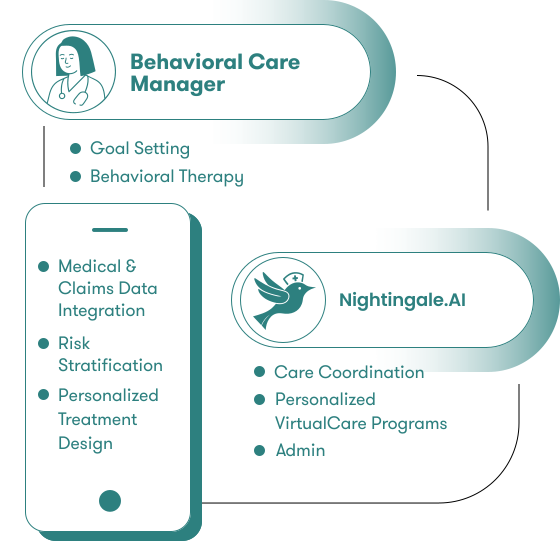
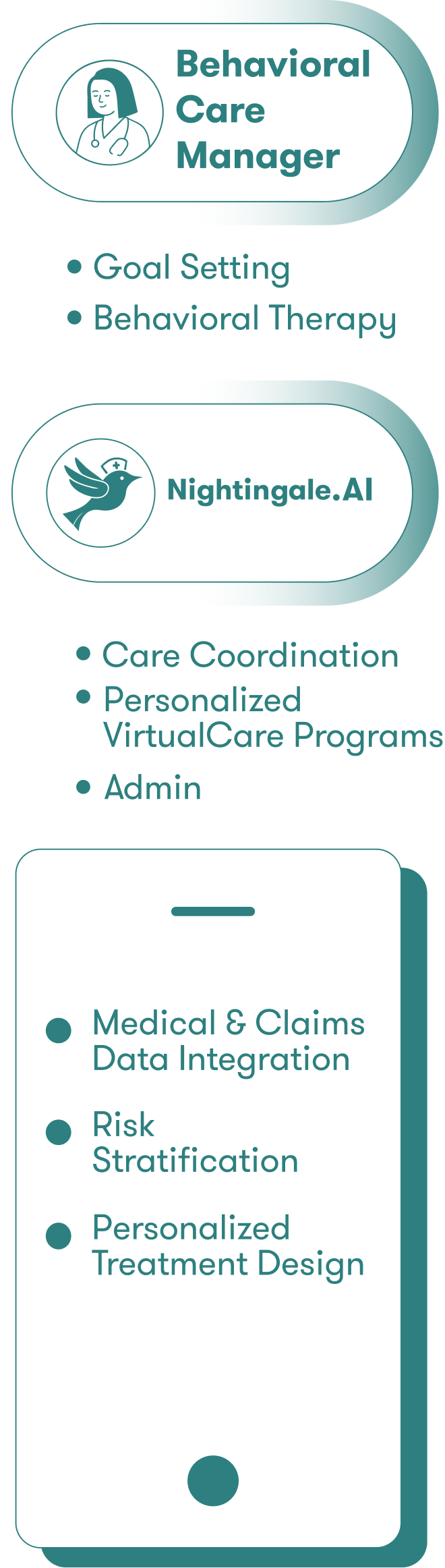
Nightingale reads these together, so the care team starts from a list of patients instead of a list of unanswered questionnaires.
Nightingale AI

One engine reading the whole record, not one questionnaire at a time.

Nightingale sweeps the panel every month and hands the care team a ranked list of people to reach, with the reason attached.

What Nightingale reads
Screener scores
Diagnoses
Prescription fills
ED and inpatient events
Visit notes
Referral status
Social needs
Nightingale
Reads the available record each month across the panel, so no one is missed for lack of a screen
What the care team gets
Every patient, with a clear next step
High risk Reach out today
Getting worse Reach out this week
Missed care Fix at the next visit
Doing okay Re-screen later
Care managers work this list. AI helps with the outreach.
How it works

The care coordinator that never loses the thread.

Scroll through what it does. The panel on the left responds.

Proactive outreach

Reaches every enrolled patient on cadence, in their own language, between visits. It contacts the people who never call back, so no one goes quiet for a month.

Live registry

Every enrolled patient tracked to target. The ones not improving surface first, so the care team spends its time where a score is actually stuck.

Billing-ready documentation

Time and contacts logged against the monthly CoCM thresholds automatically, so the work you already do turns into a clean, reimbursable claim.

The product

One system, many surfaces.

Nightingale.AI is not a single dashboard. It is the layer doing the between-visit work, wherever the work happens.

In-language outreach, drafted and approved
NightingaleDrafted for Louise M. (Cantonese): checking in on sleep and medication this week.
Care manager edited and approved.
NightingaleSent · reply received in 4 min
Symptoms tracked to target
PHQ-9 · Louise M.14 → 6
Wk 1Wk 12
The work queue, ranked
Titration flagPHQ-9 stuck at 12 · 3 wks
No-show riskMissed 2 check-ins
Reachable nowBest window: 9–11am
Who we serve

Built for the people who carry behavioral health risk.

Primary care practices

Treat behavioral health in-house and get reimbursed for the work you already do.

  • Care managers and psychiatry, staffed for you
  • Runs in your existing EHR and schedule
  • Covered for Medicare and Medicaid patients

Health systems

Extend behavioral health across your network, without building a new department at every site.

  • Deploys across employed and affiliated practices
  • Fewer behavioral-health-driven ED visits and readmissions
  • Moves system-level quality and Stars measures

Payers and ACOs

Reach the members driving avoidable cost, and move the quality measures that matter.

  • Population reached, not just screened
  • Impact on total cost of care
  • HEDIS and Stars behavioral measures
Why it holds up

The most evidence-based model in behavioral health.

Collaborative care is about as settled as anything in the field. Integral Health delivers it with the operational rigor that decides whether the evidence ever reaches a patient.

90+
Randomized controlled trials supporting the model
National
Medicare coverage, and Medicaid in a growing number of states
Measurement based
Every patient treated to target, not referred and forgotten

See collaborative care running in a practice like yours.

Request Demo